Franco Mazzucchelli
April 26, 2026 - June 14, 2026
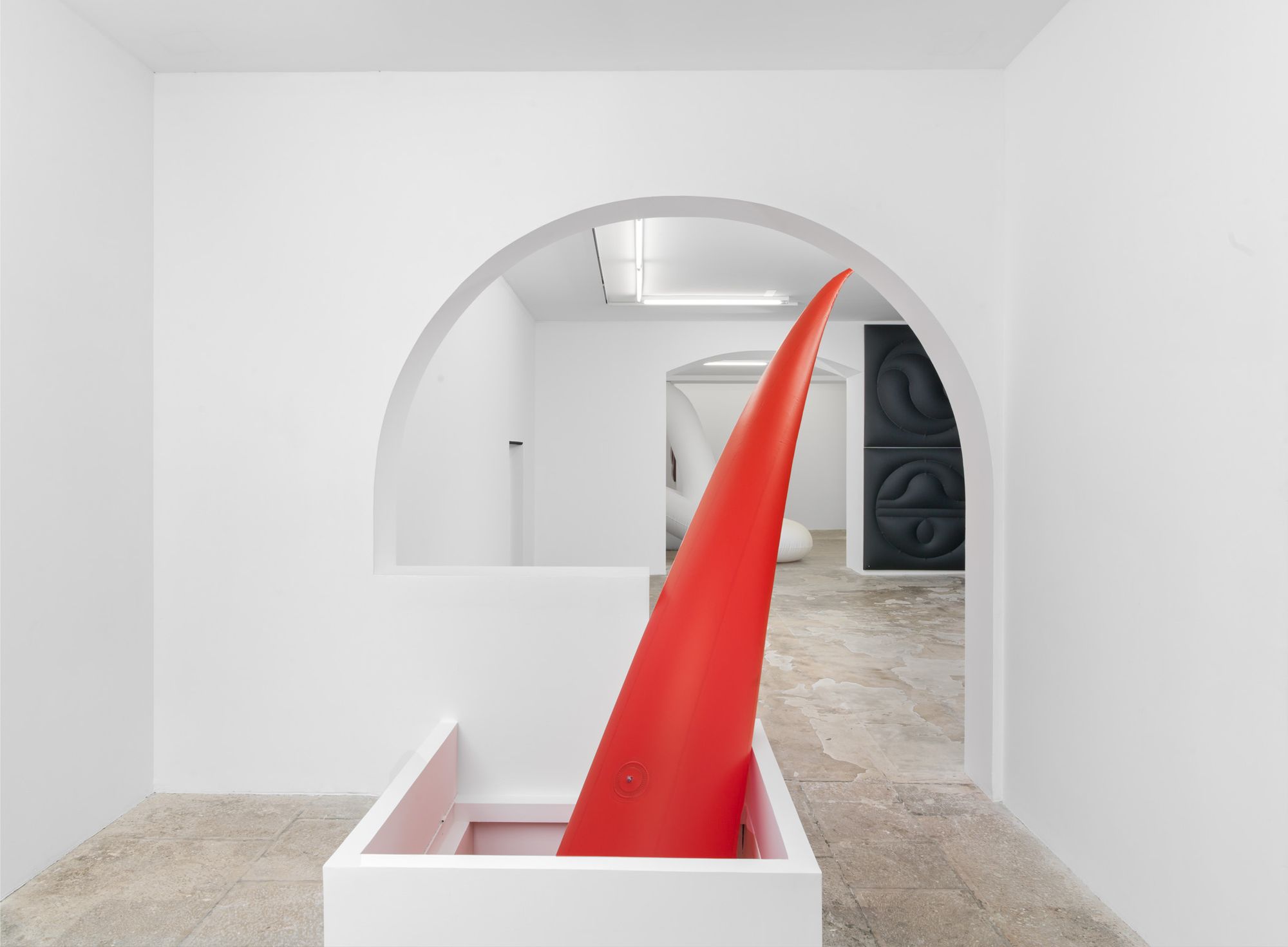
Franco Mazzucchelli (b.1939, Milan) for more than six decades has pursued a practice grounded in participation, impermanence, and social interaction—transforming lightweight industrial materials into poetic, disruptive presences. As radical now as when he first began, Mazzucchelli employs the most elemental of materials - air - to radically redefine the medium of sculpture.
For Mazzucchelli, air becomes volume, structure, tension and a method of engagement.
His works are not based on carving, modelling, or casting solid materials - they are instead born from an obsession with mathematics, equations and the root and definition of form. The process is both industrial and sartorial - he cuts and welds plastic membranes, meticulously tailoring each work himself in his studio in Milan.
His first ever installation of a sculptural work was in 1964, 62 years ago, in the Camargue, inflated with the exhaust from his car - this marked the beginning of a career dedicated to a radical form of thinking and action.
Trained at the Accademia di Belle Arti di Brera in Milan during the late 1950s, Mazzucchelli emerged at a time when Italian art was undergoing profound change. While many of his contemporaries explored conceptualism and Arte Povera, he charted a parallel but distinct course.
By the mid-1960s, he began working with PVC and other synthetic materials, creating large-scale inflatable sculptures that defied the norm. Often placed in public squares, parks, and urban peripheries— each site held specific and distinct social parameters allowing for each engagement to be distinct. Schools, factories, parks - each unique and generative of a new and distinct result.
In 1964, he initiated his seminal series “Abbandoni” (“Abandonments”), the same year he met Marcel Duchamp in Paris. The works were not simply displayed; they were entrusted to the city and its inhabitants. Passersbys could climb, touch, damage, or even claim them. By relinquishing control, Mazzucchelli questioned the authorship of the artwork and anticipated later discourses around relational aesthetics and participatory practice. The works’ radicality cannot be underemphasised.
Throughout the 1970s and 1980s, his inflatables grew increasingly monumental, sometimes enveloping architectural facades or filling interior spaces with immersive, pulsating color. The sculptures’ glossy surfaces and biomorphic shapes oscillated between playful and uncanny, feeling at times alive, but equally vulnerable - relying solely on air.
On view in this new exhibition, alongside a series of sculptural interventions, are documentary films, and archival photographs, charting his large scale public interventions, the first of which was in San Fedele in Milan, which featured over 80 inflatables, many of which were taken by the public.
Alongside the works on view at the gallery, Mazzucchelli is activating two outdoor, public, works.
One on the water at the Port des Pecheurs, and the second in the gardens of the Villa Natacha. One a pure geometric form, “Bicono specchiante”, 2026, the other an immersive experiential work “Riappropriazione” (1974-2026), both are emblematic of his masterworks, brilliantly elemental ,and connected across time, creating powerful human synergies, the kinds only a radical of Mazzucchelli’s stature could create.